You turn over the Seven of Pentacles and glance past it, hoping the next card will be The Lovers. The glamorous cards are easy to notice. Yet the Minor Arcana meanings may give you the more interesting question: what are you putting time into, and how do you feel about the way it is growing?
Those smaller scenes are the heart of this guide. We’ll look at the four suits, the court figures and eight everyday examples. You can use them to explore a question without treating a card as proof of another person’s intentions or a forecast you must obey.
What are the Minor Arcana?
In short: The Minor Arcana are the 56 cards in the four suits of a standard 78-card tarot deck. Each suit contains an Ace, cards 2 to 10, and four court cards. Their meanings vary across decks and traditions; here they offer a vocabulary for everyday reflection.
The V&A’s history of tarot describes the familiar suits of cups, coins, swords and wands, along with tarot’s earlier use as a card game. The modern spiritual interpretations are part of the cards’ later history. They should not be mistaken for a universal system handed down unchanged from antiquity.
In many illustrated decks, the Major Arcana provide larger archetypal scenes while the Minors invite attention to a particular exchange, task or feeling. That is a useful reading approach, rather than a rule that one group handles destiny and the other tells you exactly what will happen tomorrow.
If the whole deck still feels unfamiliar, start with our beginner’s tarot roadmap. Then return with one question and a card in front of you. Looking carefully at an image is a more manageable beginning than trying to memorise fifty-six definitions in one sitting.
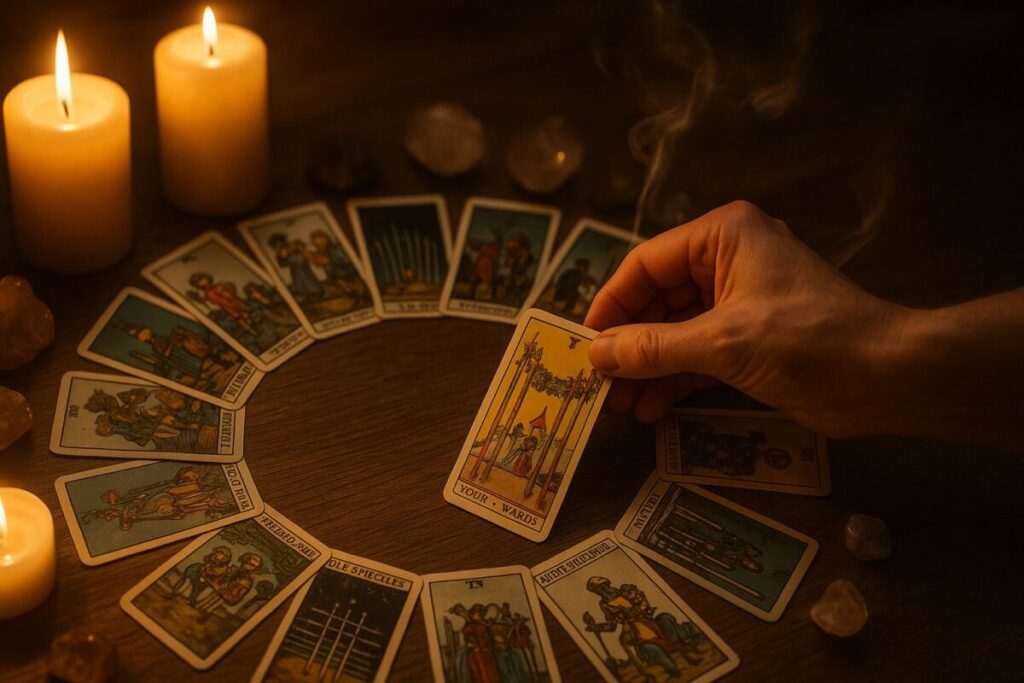
A card drawn from a spread can provide a focus for reflection. Its meaning depends on the question, the deck and the interpretation you choose.
Four suits, four different starting questions
Cups: what is happening emotionally?
Cups are commonly associated with water, feelings and relationships. In a reflective reading, they can prompt questions about affection, disappointment, support or belonging. A Two of Cups might suggest an exchange between two people; a Five of Cups can open a conversation about loss and what remains.
Keep the question on something you can explore. “What kind of support would help me?” is more useful than using a Cup card to declare that someone secretly loves you. The image can help you describe a feeling without giving you access to another person’s private experience.
Pentacles: what needs practical attention?
Pentacles, also called coins in some decks, are associated with earth and material life. Think of work, resources, routines and the practical side of a plan. A Three of Pentacles may suggest cooperation; a Four can raise questions about holding on or feeling secure.
For example, a reading about a new project might lead you to ask who needs to be involved or what supplies you already have. It cannot determine an investment return or replace financial advice. The useful part is the practical question you can investigate afterwards.
Swords: what am I thinking or assuming?
Swords are commonly associated with air, thought and conflict. Their sharper pictures can look alarming, especially when you are already worried. Rather than turning a dramatic image into a prediction, notice which part of the question it brings into focus.
A Nine of Swords might prompt you to name a worry. A Six could suggest considering a transition or a different perspective. Neither diagnoses a mental health condition. Ask what is known, what you are imagining and where more information would help.
Wands: where do I want to put my effort?
Wands are associated with fire, action and creativity. They suit questions about enthusiasm, direction and how much you are trying to carry. The Eight can suggest movement in a reading; the Ten can make a useful image for an overloaded schedule.
Picture a week crowded with commitments. Instead of concluding that a card has diagnosed burnout, ask which task belongs to you and which agreement could change. The symbol opens the discussion; your circumstances determine what is possible.
Eight Minor Arcana meanings to try as questions
These are sample interpretations, not fixed verdicts. Begin with the picture in your own deck, then consider how the question fits. If it does not fit, you do not need to force your life into the card’s story.
Ace of Wands: a beginning worth exploring
A spark can suggest a new idea or renewed interest. Ask: “What would I enjoy trying on a small scale?” A first sketch or a conversation may tell you more than announcing a complete reinvention.
Seven of Pentacles: a pause to review
An image of waiting or tending can invite a review of effort. Ask: “What am I learning from the work so far?” Patience may be useful, but the card does not require you to keep investing in something that no longer suits you.
Eight of Swords: a restriction to examine
Look at what appears to limit the figure. Ask: “Which obstacle is practical, and which part am I assuming?” Some restrictions are real and need outside help. Avoid telling yourself that every difficulty exists only in your mind.
Queen of Cups: attention to a feeling
This figure can suggest listening or emotional care. Ask: “What feeling needs words before I act?” You might speak to someone you trust, write a note or simply acknowledge a mixed response.
Three of Wands: a wider view
The outward-looking scene can suggest considering what comes next. Ask: “What information would help me explore this possibility?” Curiosity does not oblige you to make a major move before you understand it.
Five of Cups: space for disappointment
A loss-focused image may help you name what hurts. Ask: “What am I missing, and what support remains available?” Noticing support does not mean rushing yourself out of sadness or pretending a loss is a gift.
Ten of Swords: a story about endings
The dramatic scene can prompt a question about completion. Ask: “Which part of this situation is over, and which part needs attention now?” It is not a prediction of injury or a demand to end a relationship.
Four of Pentacles: holding and releasing
The figure’s grip can suggest security, caution or attachment. Ask: “What am I protecting, and is this arrangement still useful?” Sometimes holding a boundary is appropriate; sometimes a practical adjustment gives you more room.
Reading the court cards as roles and qualities
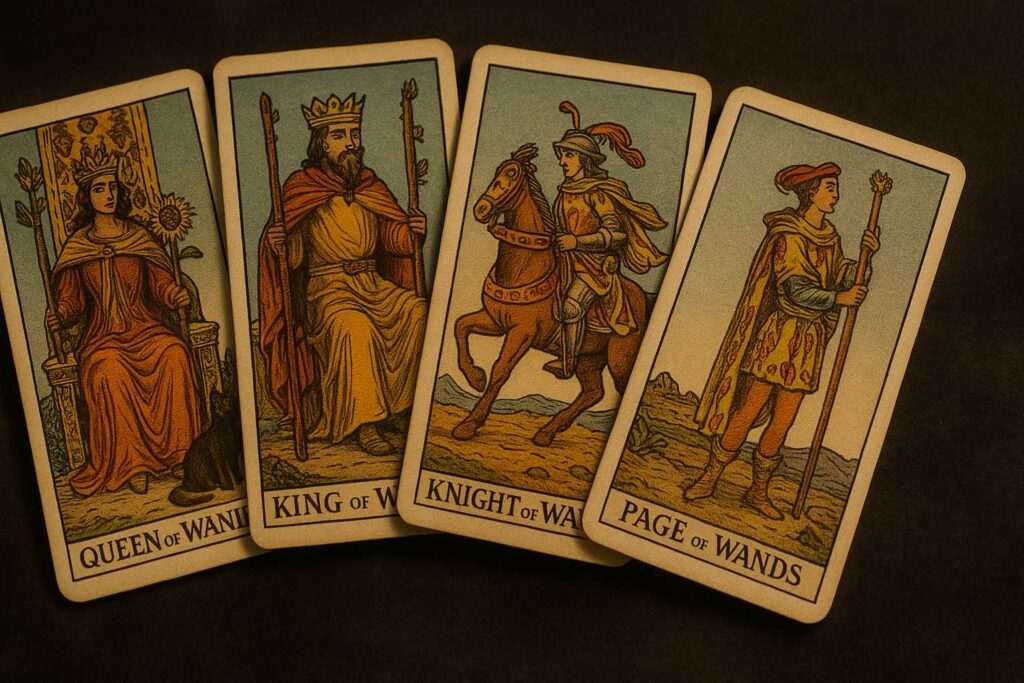
The Queen, King, Knight and Page of Wands illustrate four court figures. They can be read as roles or qualities, rather than literal predictions about people.
Pages, Knights, Queens and Kings can represent people, roles or approaches within a reading. One possible sequence is curiosity, action, thoughtful stewardship and responsibility. Different decks describe these figures differently, so let the guidebook tell you which approach its creator uses.
You need not assign a gender, age or appearance to someone because a court card appears. A Queen can suggest a quality you want to practise; a Knight can raise a question about how quickly you are moving. Try the interpretation against the question instead of searching for a person to fit it.
A daily practice that leaves room to disagree
Choose one card and write three short lines: what you can see, the interpretation you are considering, and a question it raises. Keep those lines separate. “A person is holding four coins” is a visual observation. “I am worried about security” is your interpretation, which may or may not fit.
Later, you can revisit the note and record what actually happened. Include the occasions when the card did not feel relevant. That makes the notebook an honest record of your reflections rather than a collection of apparent predictions selected after the event.
For a more structured question, the six-card stay-or-go spread offers positions to explore your own needs and options. Keep decisions with the people involved, and seek suitable professional help when the issue concerns health, money, law or safety.
Key takeaway: Read the Minors as a set of possible questions. Their detail can make a reflection more specific without making its answer certain.
If you would enjoy talking through a tarot question, read what an ethical reading can offer first. A conversation for entertainment and self-reflection can help you express the question; it does not replace evidence or decide your future.
Questions beginners ask about the smaller cards
Do I need to memorise all 56 Minor Arcana meanings?
No. Learn the four suits, then use your deck’s guidebook alongside close observation. You can build familiarity gradually while remaining open to different interpretations.
Can I read with only the Minor Arcana?
Yes, if that is the approach you want to explore. You might use them for everyday questions about work, feelings or choices. A smaller selection does not make the result more certain.
Do the court cards always describe people?
No. They may suggest a role, a quality or an approach to a situation. Avoid assigning someone an identity, motive or gender solely because a card appears.
What if my deck uses different suit names?
Check its guidebook. Coins and Pentacles, for example, may describe the same suit in different decks. Some creators rename the suits or court figures to suit their imagery.
Should a difficult-looking card worry me?
A dramatic image is not proof that something bad will happen. Notice your response, then return to the question and the interpretation. You can put the cards away if the activity stops being useful.
About the Author
The Esmeralda Chat editorial team writes about relationships, tarot, astrology and spiritual self-reflection. We pair traditional symbolism with practical questions, keeping your own choices at the centre.
Disclaimer: This article is for entertainment and self-reflection purposes. It doesn’t replace medical, legal, financial or mental health advice.