The smell of roasting herbs, the sudden chill in the air, the sound of a game on TV in the other room. Thanksgiving is a holiday that arrives on our senses full-force.
For many of us, it’s a complicated knot of feelings. There’s the joy, the food, the nostalgia. And then, there’s the other stuff. The pressure to cook a perfect meal, the subtle (or not-so-subtle) family dynamics, the ghost of the empty chair, and the exhausting weight of expectation.
It can feel like a day we just have to get through.
But what if we looked at it differently? What if we saw Thanksgiving not as a single day of forced smiles, but as a powerful energetic checkpoint? A modern-day harvest festival for the soul.
In short: Thanksgiving is a seasonal turning point the whole culture pauses for. Used intentionally, it’s four practices in one day: a harvest reflection, an ancestor honoring, kitchen alchemy with the four elements, and an empath’s toolkit for surviving the family table. Gratitude isn’t about pretending things are fine. It’s about training the eye to see the good alongside the hard.
The entire universe is built on cycles. We plant, we tend, we reap. We’ve just moved through the fiery energy of summer and the reflective shadow work of autumn. Thanksgiving is the pause right before the deep winter sleep. It is the collective exhale.
Spiritually, this day is a potent portal. It’s an opportunity to consciously count our blessings, to honor our lineage, to practice real, alchemical magic in our own kitchens, and to set the energetic tone for the rest of the year.
This is your guide to reclaiming the magic of a spiritual Thanksgiving. Not as a day of perfection, but as a day of powerful, personal, and profound spiritual practice.
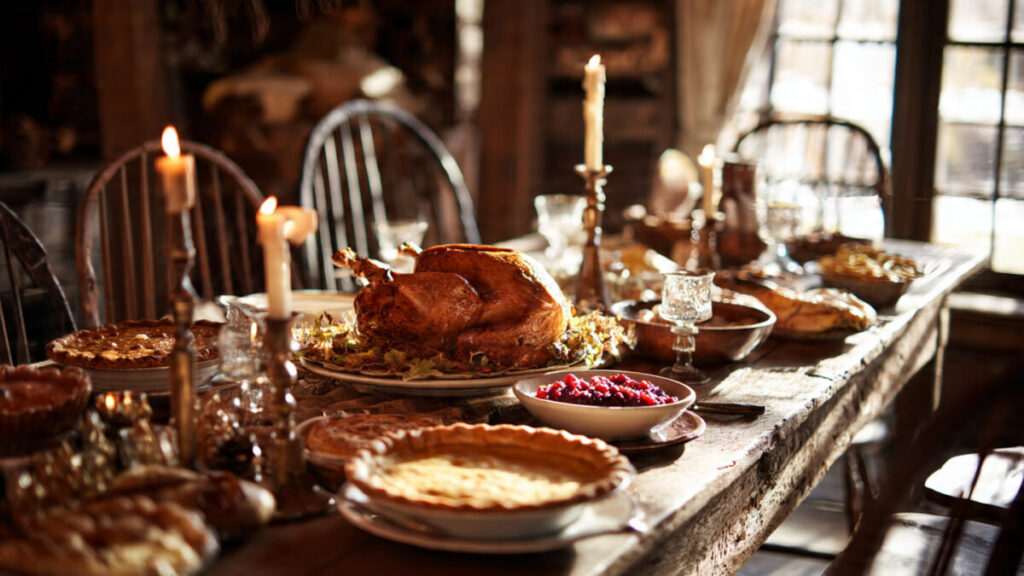
The gratitude paradox: when thankfulness feels like a chore
Let’s get one thing straight: « just be grateful » is terrible advice.
We live in a culture that can sometimes promote « toxic positivity, » the idea that we should just paper over real pain, frustration, or sadness with a layer of forced thankfulness. That’s not gratitude. That’s spiritual bypassing.
You are allowed to be deeply grateful for your home and simultaneously deeply annoyed that your cousin is bringing their new, obnoxiously loud partner. You can be thankful for your health and also grieving a friendship that ended.
Real gratitude isn’t about ignoring the difficult parts of life. It’s about acknowledging them and choosing to also see the good. It is an active, alchemical process.
Think of it this way: gratitude is one of the highest vibrational frequencies we can hold. It is the frequency of abundance, of receiving, of being in flow with the Universe. When you are in a state of genuine gratitude, you are literally telling the Universe, « yes, more of this, please. » Research from UC Berkeley’s Greater Good Science Center, led by gratitude researcher Robert Emmons, PhD, finds that regular gratitude practice produces measurable increases in positive emotion, sleep quality, and relationship satisfaction across studies of more than a thousand participants.
The problem is, when we’re stressed or hurt, our frequency drops. We get tuned to the « static » of anxiety, resentment, or scarcity.
Thanksgiving, with its collective focus on thankfulness, acts like a giant energetic amplifier. It makes the « signal » of gratitude stronger and easier to tune into, even if your personal life feels like static. The magic happens when you stop seeing gratitude as an obligation and start seeing it as a tool. It’s the key that turns the lock.
Key takeaway: gratitude and grief can share the same day. The goal is not performative thankfulness but honest gratitude held alongside everything else you feel.
Reframing the feast: four pillars of a magical Thanksgiving
You don’t need a special altar or a complicated formula to make Thanksgiving sacred. The magic is already there, woven into the very fabric of the day. We can break it down into four powerful pillars.
Pillar one: the magic of the harvest
This day is, at its core, a harvest festival. Ages ago, this was the time to celebrate that the barns were full, that there was enough food to survive the coming winter.
We may not be farmers, but we are all tending something. Before the chaos begins, take a moment. Look back at the year. What did you « harvest »? It’s not just about the big wins, like a new job or a new home.
- Did you harvest a difficult lesson?
- Did you harvest a moment of profound clarity?
- Did you harvest the strength to walk away from something that was no longer for you?
- Did you harvest a new friendship, or a deeper connection with your own intuition?
Even the « failures » are a harvest. They are the compost that will feed next year’s garden.
A simple practice: place a beautiful bowl and some small slips of paper on a side table. As your guests arrive, ask them to write down one thing they « harvested » this year, a lesson, a joy, a success, and place it in the bowl. Before the meal, read them aloud. It shifts the energy from polite small talk to genuine, shared celebration.
Pillar two: setting a place for the ancestors
Family. There is no day more loaded with family energy than Thanksgiving. This includes the family we see, the family we miss, and the family we never knew.
This is a powerful time to honor your ancestors. We are the living sum of their stories, their struggles, their resilience, and their love.
You can do this simply by setting an « empty plate » at the table. This is the spirit plate, a place of honor for the ancestors, both of your bloodline and of your spiritual lineage. As you place the plate, you can say a silent prayer, inviting in their wisdom, their protection, and their love.
This is also a day to heal. If your ancestral line is filled with trauma, you can use this plate as a place to send light back. To say, « the pattern stops with me. I honor your journey, and I am healing it for us all. »
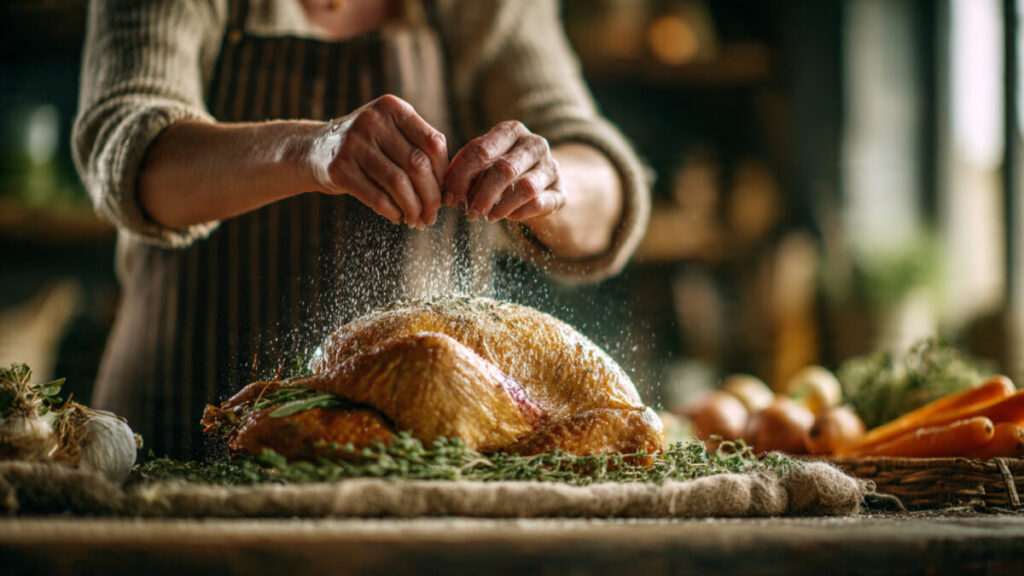
Pillar three: kitchen witchery and elemental magic
The kitchen is the modern mystic’s laboratory. It is the place where all four elements come together to create nourishment and magic. When you practice kitchen witchery, you are literally an alchemist when you cook.
- Fire: the stove, the oven. This is the element of transformation and passion. As you turn on the heat, set an intention for what you wish to transform in your life.
- Water: the soups, the sauces, the act of cleansing. This is the element of emotion and intuition. As you stir the gravy (always stir clockwise to draw in love), infuse it with feelings of peace.
- Earth: the food itself. The root vegetables, the herbs, the grains. This is the element of grounding and nourishment. As you chop vegetables, feel your own connection to the earth.
- Air: the steam, the incredible aromas, the chatter and laughter. This is the element of communication and shared breath. Let the scents of sage and rosemary cleanse the air.
Cooking this meal isn’t a chore; it’s a moving meditation. Every stir, every chop, every pinch of salt is an opportunity to pour your love and intention directly into the food you are about to share. For a parallel framing on why these small daily practices compound, see our companion piece on why your spiritual practice needs structure.
Pillar four: the empath’s survival guide to the table
Now, for the most practical magic of all. How do you protect your own energy when you’re in a room full of clashing beliefs and unspoken tensions? This is especially true for those of us who are empathic.
Your peace is your priority. Here is your spiritual toolkit:
- The bubble of light: before you walk in, visualize a beautiful bubble of shimmering, protective light surrounding you. It deflects stray negativity but allows love to come in.
- Ground yourself: literally. If you can, stand barefoot on the earth for 60 seconds. If you can’t, a piece of grounding crystal in your pocket (like black tourmaline or smoky quartz) works wonders.
- Observe, don’t absorb: this is your mantra. You are an anthropologist visiting a fascinating tribe. You can observe a political rant or a backhanded compliment without absorbing it as your own. It is their energy, not yours.
- The compassionate boundary: it’s okay to politely change the subject. It’s okay to say, « I’m going to step away and check on the pies. » It’s okay to go to the bathroom just to take five deep, quiet breaths.
Key takeaway: four pillars, each solving one of the day’s built-in tensions: perfectionism (harvest), absence (ancestors), mindless chore-mode (kitchen), energetic overwhelm (empath toolkit). Pick the two that fit your house and start there.
If you walk into Thanksgiving carrying a specific question (whether to host the in-laws next year, whether a particular family dynamic is actually yours to keep carrying, whether a relationship is ready for a bigger step), a short reading the week before can give you a concrete answer to arrive with rather than spend the whole day turning over in your head.
Simple gratitude practices beyond the usual
When the classic « go around the table » practice feels stale or performative, try infusing the day with these more subtle, powerful Thanksgiving practices.
The gratitude walk
Sometime during the day, step outside for a 10-minute walk. No phone. With every step, silently name something you see, feel, or hear that you’re grateful for. « The crunch of this leaf. » « The warmth of my coat. » This granular, present-moment gratitude is incredibly grounding. If you want to extend this into a daily habit after the holiday, our spiritual digital detox guide walks through how to build similar phone-free windows into the rest of the year.
The burning bowl of release
You can’t harvest new crops if the old, dead ones are still in the field. Before the day begins, write down something you are ready to release from this year (a bad habit, a resentment). In a safe, fireproof container, light the paper and watch it burn to ash. You are making energetic space for new blessings.
The wishbone’s deeper magic
Don’t just snap the wishbone. As you and a partner hold it, close your eyes. This isn’t just a « wish. » It’s a powerful intention. See what you want to manifest for the coming winter season, perhaps it’s « peace, » « creativity, » or « rest. » Feel the feeling of having it. Then, pull.
The thankful water blessing
Before you take your first drink, hold your glass. Look at the water (or wine, or cider). Silently pour a feeling of deep gratitude into the glass. Thank the water for its life-giving energy. Then, drink it. You are literally internalizing the frequency of gratitude.
The spirit plate for your lineage
If the four pillars felt like too much, start here. Lay one empty plate at the table. Name it silently as you set it down: « for those who came before. » Nothing else has to change. That one small gesture is enough to turn the whole meal into an act of honoring.
Key takeaway: five practices, ranging from thirty seconds (setting the spirit plate) to ten minutes (gratitude walk). None of them require buying anything or telling anyone else at the table what you’re doing.
The true harvest
Thanksgiving is not about a perfect, magazine-worthy table. It is not about everyone getting along, or pretending that life isn’t messy and hard.
The true harvest of this day is connection. It is the choice to find the magic in the mundane, the sacred in the stress. It is a potent reminder that even in the midst of chaos, you have the power to be an alchemist.
You can transform obligation into intention. You can transform cooking into magic. And you can transform a simple « thank you » into a powerful, vibrational force that ripples out, blessing not only your own life but the lives of everyone you touch.
Frequently asked questions
What is the spiritual meaning of Thanksgiving?
Spiritually, Thanksgiving is a harvest festival. It marks the pause between the growing season and the deep winter, a moment for conscious reflection on what you’ve cultivated, gathered, and lost through the year. It is also an ancestral day: the whole culture pauses at the same time, which amplifies the energetic « signal » of gratitude whether or not everyone at the table is consciously participating.
How do I practice gratitude when I don’t actually feel grateful?
Start specific and small. « I’m grateful for… » as a general statement feels hollow on a hard day. « I’m grateful for the way this coffee smells right now » is a sentence your nervous system can actually accept. Granular, present-moment gratitude (what Robert Emmons calls « appreciative noticing ») is more effective than sweeping statements. The feeling often catches up to the practice, not the other way around.
What’s the difference between gratitude and toxic positivity?
Toxic positivity says: « Don’t feel sad, look at all you have. » Real gratitude says: « I feel sad AND I can also see what is good. » Toxic positivity erases the hard feeling. Gratitude holds it alongside everything else. The test: if the practice leaves you feeling more dissociated from your own experience, it’s bypassing. If it leaves you feeling more connected to the fullness of your life, hard parts included, it’s real.
How can I honor my ancestors on Thanksgiving if I have a complicated family history?
Honoring isn’t agreeing with. You can set a spirit plate and silently say, « I honor the journey you took, and I am healing what you passed on. » That is a complete and whole practice. You are not required to idealize people who hurt you or your lineage. Acknowledging them, setting down what was theirs, and claiming what is yours is itself the healing work.
What’s the single best tool for an empath at a loud family dinner?
« Observe, don’t absorb. » Treat the loud uncle or the passive-aggressive sibling like weather you are walking through, not weather you are made of. Their political rant is their nervous system speaking, not an invitation for yours to match. Pair it with a physical grounding tool (a stone in your pocket, a bathroom break for five slow breaths) and the four-hour dinner feels like a two-hour one.
Can a psychic reading help me with family dynamics?
Yes, particularly when the same pattern keeps repeating year after year and you cannot see what you’re doing in it. A reading can identify the role you were assigned in the family dynamic (the peacemaker, the scapegoat, the fixer, the invisible one), which is usually the first step in being able to choose a different role. It also helps to have a specific question to arrive with rather than a diffuse sense that « family is hard. »