Imagine discovering that your romantic future depended on which slice of cake you were handed. In Irish Halloween tradition, a ring hidden in barmbrack, a fruit loaf, was believed to foretell marriage for whoever found it. A delicious piece of Halloween history, unless the person you fancied was sitting beside somebody else.
Halloween history brings together Samhain, Christian observances of saints and souls, local folk customs and later American celebrations. Its association with love belongs to that history too. Cake, cabbages and roses have all been asked to settle questions that people still struggle to put to one another.
This year, Halloween falls on Saturday, 31 October 2026. While the weekend gives us an excellent excuse to linger over dinner or dress up extravagantly, the older story begins with something more pressing: winter was coming.
Halloween history: Samhain and All Hallows
Samhain: the turn towards winter
Samhain belongs to the Gaelic seasonal calendar and is particularly associated with Ireland. Say it roughly “SOW-in”, with the first syllable rhyming with “cow”. Its roots lie in the turn from harvest into winter, when the changing season shaped the work and food of communities living close to the land.
In the traditional Irish calendar, Samhain falls on 1 November, the beginning of winter. Celebrations began the evening before, Oíche Shamhna. That’s why 31 October belongs in the story.
Picture that evening without streetlights. Beyond the window, the familiar road disappears into darkness; indoors, someone is talking and there’s something to eat. You don’t need to share the beliefs of an earlier century to appreciate the attraction of staying close to the voices.
Recorded Irish folklore associated the night with returning spirits and otherworldly visitors. Feasts, disguises and games accompanied these beliefs. People remembered the dead and gathered for an evening that mixed uneasiness with enjoyment.
Historians also disagree about precisely how Halloween began. UCLA’s discussion with folklore scholars distinguishes cultural influence from a simple origin story. That’s a reason to enjoy the recorded customs without assuming that every modern detail is an unchanged ancient survival.
All Hallows’ Eve: saints, souls and Halloween’s name
The name Halloween comes from All Hallows’ Eve, the evening before All Saints’ Day on 1 November. “Hallows” means saints. All Souls’ Day follows on 2 November in the Western Christian calendar, a day of remembrance and prayers for the dead.
Samhain and Halloween therefore name overlapping histories. Samhain is the Gaelic seasonal festival; Halloween’s English name comes from the Christian calendar. In Irish, Oíche Shamhna is also the name for Halloween. Over generations, local customs and religious observances mingled, and later American celebrations added further traditions. The familiar account of one festival simply replacing another gives us a tidier history than the evidence supports.
There’s an intimacy to this part of Halloween history. For anyone missing someone who’s died, a familiar recipe can bring them close: you make the pudding your mother loved, remember her instructions almost exactly, and wish you could ask her about the bit you’ve forgotten. At the table, somebody tells a funny story about her. The evening has room for that affection as well.
Soul cakes, disguises and “trick or treat”
Picture a small vampire on your doorstep, holding out a bag with considerable confidence. “Trick or treat” contains a bargain: give us something nice, or risk a prank. That’s the “trick”; the sweets are the “treat”. The visit has older European parallels, although the familiar greeting came much later.
One of those parallels is souling. In medieval England, poorer neighbours went from door to door around All Souls’ Day, asking for food or charity. Better-off households gave them small “soul cakes”; in return, the visitors offered prayers for the family’s dead. Later accounts, especially from the nineteenth century, often describe children taking part. That’s the connection with trick-or-treating: a visit from house to house in the hope of receiving food.
Another related custom, guising, brought costumes into the exchange: visitors dressed up and entertained the household to earn treats. Library of Congress folklife research cautions, however, that these similarities don’t establish one proven, direct line to modern trick-or-treating.
By 1927, “trick or treat” appeared in a newspaper report of Halloween in Blackie, Alberta, an example cited by Oxford County Archives. In the United States, folklorist Tad Tuleja places the practice in the 1930s, with wider adoption later. The Canadian archives describe its growth in the 1950s as expanding suburbs made the rounds from house to house easier.
From Irish turnips to American pumpkins
A carved turnip is a surprisingly effective argument for leaving the landing light on. The National Museum of Ireland’s ghost turnip collection record shows the sort of face that makes our round orange pumpkins look positively welcoming.
Among the objects is Eileen Barnes’s painted plaster model of a turnip lantern sent from County Donegal in 1943; its accompanying account recalled similar lanterns around 1900. The museum identifies the pumpkin lantern as an American development of the Irish custom.
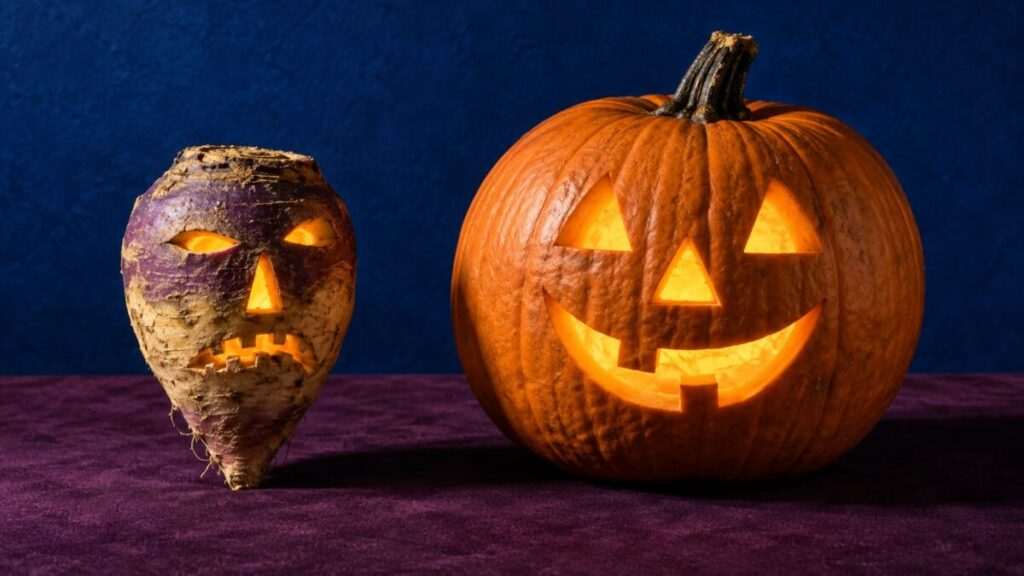
Modern AI-generated illustration of turnip and pumpkin lanterns.
Irish immigrants helped spread Halloween celebrations in nineteenth-century America, bringing parties and fortune-telling with them. In new surroundings, familiar customs acquired new forms.
Halloween and love: from fortune-telling to flirtation
The fortune-telling at those parties often returned to one delicious question: who would fall in love? The ring in the fruit loaf had plenty of competition. People turned to ordinary objects for answers to questions they were too shy to ask aloud.
Love games: cabbages, roses and a hopeful heart
In another Irish custom, people picked cabbages blindfolded and read their size, shape and roots as clues about a future spouse. Quite a responsibility for something ordinarily destined for dinner.
Across the Atlantic, a Philadelphia newspaper offered readers a selection of sweetheart tests for Halloween 1914. The Library of Congress preserves one in which two entwined roses represented two people. According to the game, a deepening colour meant the lover’s affection was true.
Of all the objects people asked to predict a romance, roses seem the best choice. Still, imagine watching them the following morning, trying to decide whether the petals really looked darker or whether you simply wanted them to.
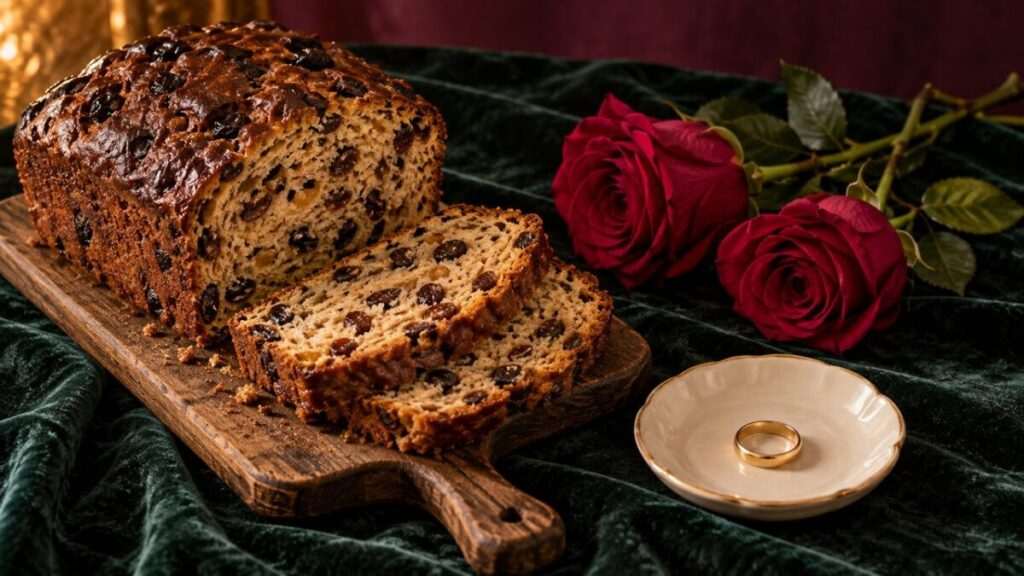
Barmbrack, a ring and roses in a modern AI-generated illustration.
These were folk beliefs and party entertainments. They don’t have a dependable power to predict marriage. Their appeal is easy to understand: before you let yourself love someone, you’d like to know that they feel the same way.
The old accounts often assume that a woman’s happy ending will be a husband. Your own hopes can take whatever shape fits your life, including a single life you’re perfectly happy with. If you’re curious about a present-day form of divination, our beginner’s tarot guide introduces the cards and how a reading is arranged.
The glamorous witch in Halloween’s imagery
Courtship also found its way into Halloween’s imagery. Long before the party-shop minidress, glamorous witches appeared in early-twentieth-century American illustrations. Smithsonian historian Daniel Gifford connects these alluring figures with changing ideas about women’s independence and control over their romantic lives.
It’s a story told through illustrations; it doesn’t measure which costumes most women wore. Today, your costume can be flirtatious, funny or magnificently impractical. You get to choose the character you’d enjoy playing for an evening.
What Halloween can bring to your love life today
A Halloween costume gives you something to talk about before you’ve even introduced yourself. Here’s how to make the evening your own.
-
Singles: Ask how someone made those magnificent wings, or which film inspired their costume. It’s an easy way into a conversation that tells you something about them. If you’re enjoying it, suggest getting a drink together before the next party game.
-
Couples: Choose a theme for your pumpkins, then keep your designs secret until the grand reveal. You’ll soon discover how differently you picture a “friendly ghost”. Or dig out a photograph of your first Halloween together and recreate the costumes, if you dare.
-
Old flames: An ex’s costume photo can make a message feel wonderfully casual: “Remember when we went as…?” Before sending it, decide whether you want a conversation with them now or simply miss that particular Halloween. If it’s the memory, share the story with a friend instead.
By the time the cake comes round, you might already be enjoying someone’s company too much to worry about what’s hidden in your slice.
If this season has brought a love question to the surface, you can bring it to an Esmeralda Chat reading. “What do I want from my next relationship?” is a thoughtful place to begin. Our guide to what to ask about love in a reading offers more starting points.
New members receive five free messages after registration. Further messages use paid credits; check your reader’s rate and pack price before continuing.
About the Author
Written by the Esmeralda Chat editorial team, covering astrology, tarot and spiritual self-reflection.
Disclaimer: For entertainment and self-reflection. Spiritual interpretations are beliefs, not verified predictions or substitutes for medical, legal, financial or mental health advice.
Keep Exploring