The window reflects your room until you switch off the lamp; then the January Moon becomes easier to notice beyond the glass. The Wolf Moon 2026 is the year’s first full Moon, on January 3. Its name and traditional Cancer symbolism can offer a winter reflection on belonging, home and personal space. They do not establish that a stronger feeling is a command, a hidden truth or an effect of the Moon.
In short: The Wolf Moon 2026 reaches its full phase on January 3 at 10:03 UTC. Wolf Moon is a traditional name used for a January full Moon, rather than a separate physical type of Moon. Tropical astrology places this one in Cancer and uses home and care as interpretive themes. The date and position are astronomical references; emotional and relationship meanings remain symbolic.
Wolf Moon 2026: The Date Before the Meaning
NASA’s January 3 sky note identifies the full-Moon instant as 10:03 UTC. That is 5:03 a.m. in New York and 10:03 a.m. in London. Full phase is one instant in a continuous cycle, not a required evening appointment. Your location and conditions determine when you can look at the Moon; you do not need to see it at the exact instant to enjoy the occasion.
In the checked NASA/JPL Moon-position data, the apparent geocentric longitude is about 103.03 degrees at that instant. Tropical astrology labels the interval from 90 to 120 degrees Cancer. That convention explains the article’s sign label. It does not establish a double-strength lunar influence, a physical effect on your chest or a prediction about family matters.
The NASA explanation of the Wolf Moon name notes its use for a January full Moon and acknowledges other names used by different cultures. This guide does not assign one universal origin to every tradition. You can enjoy the wolf image without assuming that a particular community used it in the same way, or that the name supplies scientific evidence for an emotional meaning.

A winter-window image offers a pause for reflection; a feeling still deserves its own context.
The Wolf Image: Belonging Without Losing Your Own Space
For this reflection, imagine the wolf as a picture of belonging and personal territory. Those are the themes we choose to explore, rather than a claim about what the animal is telling you. Where do you feel welcome? Where would you like more room? A friend, a home, a hobby or a familiar place may come to mind. The answer does not have to be a romantic partner.
Belonging can include warmth and disagreement. You might enjoy being with someone while needing a quieter evening or more notice about visits. Naming that wish does not turn them into an intruder. It gives you a practical question to consider. Our relationship-suitability guide looks at respect, shared repair and actual arrangements, which offer more context than an image alone.
The home theme may also bring up memories, including ones you would rather not revisit that evening. You can leave them alone. There is no obligation to explore the hardest part of your past because a Moon is full. An ordinary conversation, a familiar meal or time with someone you trust can be a better choice than a demanding exercise.
When an Instinct Feels Louder, Ask What It Concerns
An uneasy feeling can matter without proving a partner’s motive. Try describing the event beside the feeling: “The plan changed without a message, and I felt disappointed.” Keep an uncertainty visible if there is one. This is different from deciding that every sensation is either an infallible yes or a spiritual no.
The NHS relationship guidance suggests distinguishing facts from the meaning we give a situation. That can make a question more specific. Did you agree on a plan, did the other person understand it, and what would you like to ask now? The Moon’s date does not answer those questions on either person’s behalf.
You do not need to dismiss a concern because you cannot prove its cause. You can seek information, choose a limit or ask for appropriate support. At the same time, discomfort does not automatically identify danger, and a warm sensation does not guarantee safety. A symbolic evening should not become a test that tells you to ignore practical evidence.
Two Optional Ways to Give the Evening a Shape
A reflection beside an ordinary object
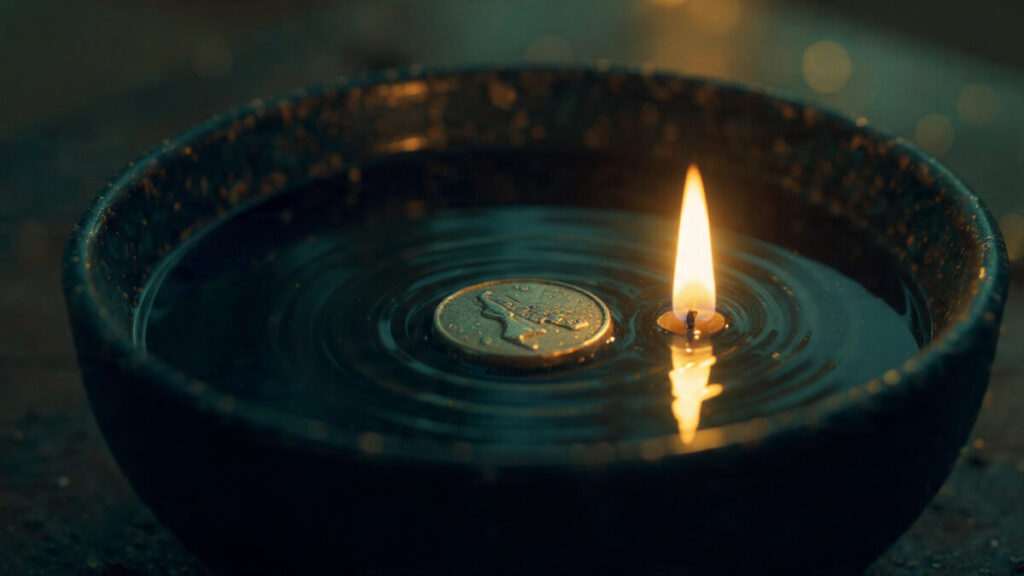
Water and a coin illustrate reflection. Objects are optional and do not reveal hidden facts.
The water-and-coin picture can remain an image of reflection. You can use a notebook instead, keep your normal lighting and leave candles or supplies out of the practice. Write two short lines: “I know…” and “I’m wondering…” The distinction may be more useful than watching for a vision that you then treat as an answer.
For example, “I know we haven’t planned the next visit” can sit beside “I’m wondering if we want the same rhythm.” A possible next step is to ask about the visit. You can also decide to think longer before speaking. An image in water, a dream or a sudden phrase may feel meaningful, but it does not establish another person’s private thoughts.
A boundary in plain words
The original winter image of putting something on ice can become a practical pause. Write what you would like to leave until another day: a reply, a decision or a conversation you are not ready to have. There is no need to freeze a person’s name, hide a container or use a declaration to control their access to you.
A real boundary might be “I can talk tomorrow” or “I need to check my plans before agreeing.” Choose words that fit the situation and do not treat the symbolic page as protection from harm. If you are frightened or controlled, qualified support matters more than finishing a reflection. Our ethical-reading guide explains why spiritual interpretations should respect practical limits.
After the Moon Evening, Keep the Useful Detail
You may feel much the same the next day. That does not mean you missed the occasion or failed to release something. If the reflection gave you a request, a wish or a question, keep that detail. You can change it when you have more information. No three-night window determines how long you are allowed to consider your love life.
The 2026 lunar calendar gives other phase dates if you enjoy following the year. For an optional spiritual conversation, bring a question about your own choices. Five free Esmeralda Chat messages are currently offered after registration; check the terms before continuing. A reader can discuss symbolism but cannot certify an instinct or guarantee a relationship decision.
Winter-Moon Questions, Answered
When is the Wolf Moon 2026 full?
January 3 at 10:03 UTC, as NASA’s January sky note confirms. That is 5:03 a.m. in New York and 10:03 a.m. in London. The exact phase instant is not a required time for reflection.
Why is this January Moon called a Wolf Moon?
Wolf Moon is one traditional name used for a January full Moon. Other cultures and calendars use other names. The name is not a physical explanation for someone’s mood or the outcome of a relationship.
What does Cancer mean in this guide?
Cancer is the tropical zodiac label for the checked Moon-coordinate interval. Home and care are interpretive themes in astrology. The coordinate supports the label, while the emotional meaning remains symbolic.
Does a full Moon make my instincts more accurate?
The astronomical date does not establish the accuracy of an individual feeling. Notice the feeling, then consider events, uncertainties and practical choices. A sensation does not reveal another person’s private motives.
Must I use water, candles or crystals?
No. You can write a few lines, enjoy the view or skip the practice. Objects are optional reminders and do not establish a stronger effect. Supplies should not become a condition for reflection.
What if I would rather stay indoors?
You can. A personal reflection does not require a view of the Moon, a particular setting or uncomfortable conditions. Choose an ordinary activity that fits the evening you want.
Will a reading tell me the relationship’s truth?
A reader may offer an optional spiritual perspective, but cannot verify hidden thoughts or make your decision for you. Practical information, consent and suitable support remain part of the actual situation.
About the Author
The Esmeralda Chat editorial team writes about relationships, tarot, astrology and spiritual self-reflection. We pair traditional symbolism with practical questions, keeping your own choices at the centre.
Disclaimer: This article is for entertainment and self-reflection purposes. It doesn’t replace medical, legal, financial or mental health advice.